Safe family car rental in Dubai for seats, space and comfort

Find a safe car rental for family in Dubai with space for child seats, luggage and comfort. Compare vehicle types and check documents, deposits and fit.
The biggest family car isn’t always the safest fit. A safe car rental for a family in Dubai should give everyone room to sit comfortably, fit the right child seat and carry your luggage without crowding the cabin. Match the vehicle to your passenger count, and check rear seat belts, ISOFIX points and boot space with Al Hurr Car Rental.
You’re right to look beyond the number of seats: a stroller or child seat can change how much room your family needs. The right choice balances comfort and space with practical features for your journey across the UAE.
This guide explains how to compare sedans, crossovers, SUVs and people carriers, what to consider when choosing a child seat, and how to understand deposit deductions and refunds. You’ll have a clearer checklist for choosing a family rental that suits your plans with Al Hurr Car Rental.
Key Takeaways
- Prepare the right documents before booking: UAE residents need an Emirates ID and valid UAE driving licence; tourists need a passport, visa and, where applicable, an International Driving Permit.
- Understand the deposit terms, return inspection and refund process so you know what can affect the amount returned and when to expect it.
- Choose a child seat that suits your child’s age and weight, and consider how it fits in the vehicle.
- Count passengers, child seats, luggage and stroller space together before settling on a vehicle size.
- Compare sedans, crossovers, SUVs and people carriers by cabin comfort and practical space, not seat count alone.
How do I choose a safe car rental for my family in Dubai?
Start with your documents, then match the vehicle to your passengers, luggage and route. For family driving in Dubai, review cabin safety and traffic conditions before booking.
Resident and Tourist Rental Documents
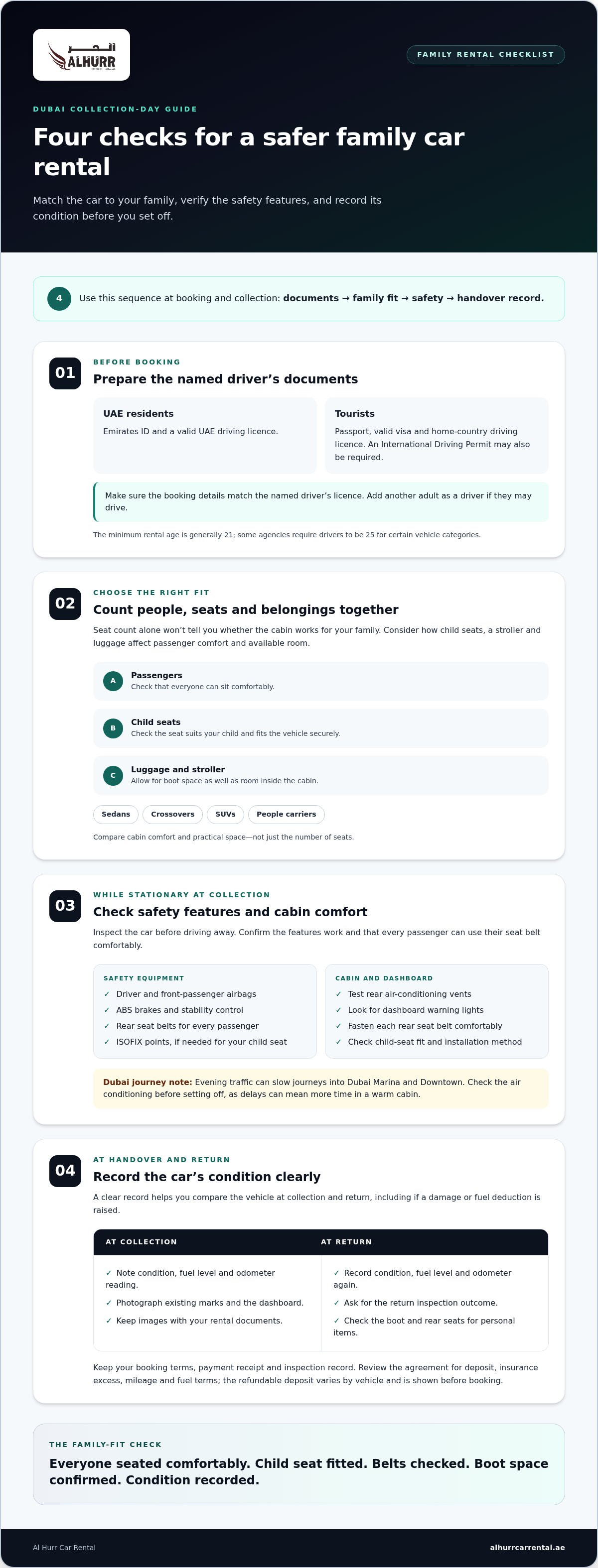
UAE residents need an Emirates ID and a valid UAE driving licence to rent a car. Tourists need a passport, valid visa and home-country driving licence, plus an International Driving Permit if required. Keep the documents ready for booking and collection, and make sure the named driver’s details match the licence. If another adult may drive, add them as a driver to the rental.
Driving Licence Requirements
Tourists from the UK, US and most EU nations can drive in the UAE using their home-country licence. International drivers whose licence is not in English or Arabic need an International Driving Permit alongside their national licence. A driving licence can be valid while a particular rental category still has an age restriction. The minimum rental age is generally 21, and some agencies require drivers to be 25 for certain vehicle categories.
Children face two practical risks on Dubai journeys: hot cabin conditions and traffic delays. Roads into Dubai Marina and Downtown can become crowded during the evening, so plan departures early where possible. A delayed journey can mean more time in a warm cabin; confirm the air conditioning works before setting off.
Before driving away, inspect the vehicle’s safety features and cabin comfort. Check for driver and front-passenger airbags, ABS brakes and stability control. Test the rear air-conditioning vents, especially if children will sit in the back. Confirm every rear seat has a seat belt and that each passenger can fasten theirs comfortably. These checks help you assess the vehicle beyond its size or appearance.
- Match the booking to the person who will drive, and prepare their original documents.
- Check that the selected driver meets the rental age requirement for the chosen category.
- Inspect the dashboard for warning lights before leaving the collection point.
- Test rear vents and seat belts while the car is stationary.
Choose an economy car or luxury car only after considering the full family setup. A compact cabin may feel manageable for a short city trip, while extra passengers or luggage can make access and comfort harder. Think through the journey, including evening travel through busy areas, before choosing the category.
At booking, enter the correct driver details and review which documents you’ll present. At collection, compare the car with your needs and complete the safety checks before driving away. A careful start helps you choose a rental that fits your family’s Dubai plans.
How quickly is the security deposit refunded after returning the car?
The refund timeline depends on the return inspection, any outstanding rental charges and how the original payment was processed. Start by reading the deposit and refund terms in your booking documents; those terms explain how deductions are handled and how a released deposit returns to your account.
Your rental agreement sets out the deposit, insurance excess, mileage and fuel terms. The refundable deposit secures applicable charges, while the insurance excess describes your financial responsibility for covered damage. Check the agreement for any mileage allowance and the required fuel level on return.
At collection, note the vehicle’s condition, fuel level and odometer reading in the handover record. Photograph existing marks and the dashboard, then keep the images with your rental documents. On return, record the same details and ask for the inspection outcome. This gives you a clear comparison if a damage or fuel deduction is raised.
A deposit refund involves the return inspection and any applicable rental charges, followed by processing through the payment provider or bank. A card hold may appear differently from a completed card charge, so compare the transaction status with your statement. Keep your booking receipt and return record until the refund is processed or any deduction is explained.
Families should also check the child seat and cabin before collection, then remove personal items before returning the car. A forgotten toy, bag or travel document can complicate handover. Take a final walk around the vehicle, including the boot and rear seats, and photograph its condition in the parking area.
The refundable security deposit varies by vehicle and is shown before booking. It does not remove your responsibility for damage, tolls, traffic fines or other charges set out in the rental agreement. Review the deposit, insurance excess and payment terms before booking rather than choosing based on the deposit alone.
- Save the booking terms, payment receipt and return inspection record.
- Photograph the odometer, fuel gauge, bodywork and interior at handover and return.
- Review how the agreement handles damage excess, mileage and fuel before travel.
- Keep payment records until the deposit release or any deduction is visible.
For a family trip, clear records make deposit questions easier to resolve and help you focus on the journey. As you compare vehicle models, browse the available rental fleet and review the terms that apply to your booking.
Child-seat availability and suitability
Child seats are available from most rental companies in Dubai, usually for an additional daily charge. Choose a seat suited to your child’s age and weight, then consider how it fits the vehicle. A seat that doesn’t fit securely or suit the child can make every trip less comfortable.
For child-seat selection, consider your child’s age, weight and height, and follow the seat manufacturer’s instructions. These fit considerations are separate from checking the applicable legal requirements. Don’t assume that choosing a suitable seat automatically addresses every legal requirement.
Before booking, provide the child’s age and weight so you can choose a suitable seat. If your child regularly uses a particular seat, bring its manufacturer’s instructions and compare its installation method with the vehicle. A familiar seat can also make a change of rental car easier for a child.
Inspect the rear seats before driving. Check for ISOFIX mounts if your child seat uses them, and confirm there is a seat belt for every rear passenger. Follow the manufacturer’s fitting instructions. Don’t improvise an installation or place the seat where its fitting method cannot be used correctly.
- Check the seat’s suitability against your child’s current age and weight.
- Match its attachment method to the vehicle’s ISOFIX points or seat belt.
- After installation, check that the seat is secure and its harness fits as instructed.
- Keep the instructions available for every driver who may use the seat.
Plan the handover as carefully as the reservation. Allow time to fit the child seat before setting off, whether you’re collecting at the airport or elsewhere. Another adult can help with fitting while you review the rear-seat layout. Don’t leave this task until everyone is waiting in a busy pickup area.
Vehicle choice matters. Different models can have different rear-seat layouts, belt positions and ISOFIX availability. Don’t assume a seat that worked in one vehicle will fit another. Check compatibility with the vehicle you’re renting and consider how the child seat affects space for other passengers.
For monthly car hire, include the seat in your longer-term planning. Repeated fitting and removal can be inconvenient, so consider whether the seat will stay installed and whether the family has enough room. Also clarify how the daily child-seat charge applies to your booking. Keep the agreement details with your travel documents.
Child-seat suitability is only one part of family comfort. Browse the vehicle fleet to compare cabin layouts, then make the child seat and passenger needs part of your car selection.
Choosing a vehicle for passengers, luggage and child seats
Yes. Families can choose SUVs or people carriers with child seats in Dubai; child seats are available from most rental companies for an additional daily charge. Match the vehicle and seat to your passengers, luggage and the full rental period, not just the drive from collection.
Start by counting adults, children and child seats. A midsize sedan may suit two adults and one child, while a crossover or small SUV may suit two adults and two children. With three children or substantial luggage, consider a larger SUV or seven-seater. These are starting points, so check the actual cabin and boot before choosing.
Seat count alone can be misleading. A five-seat vehicle may not have enough room for five people and a stroller, especially when child seats occupy rear positions. Consider your travel bags when checking the boot, and whether a folded stroller will fit without blocking access to other luggage.
Inspect the rear cabin before accepting the vehicle. Confirm every rear seat has a working seat belt, and check for ISOFIX mounts if your child seat uses them. Place the child seat where its fitting method works, then see whether other passengers can sit comfortably. Rear air-conditioning vents also matter during family trips in Dubai.
For a seven-seat layout, count usable seats after fitting child seats. A third row can add passenger capacity, but luggage space may change when those seats are in use. For example, a family carrying a stroller and several bags should assess the boot with all intended passengers seated. Rear legroom also matters on longer drives to Hatta or Fujairah.
- Count every passenger, child seat, bag and stroller before selecting a vehicle.
- Check seat belts and ISOFIX positions against your child-seat installation needs.
- Test access to the rear seats, including any third row, with children in mind.
- Consider Dubai traffic and the comfort of children during longer journeys.
At collection, inspect the vehicle’s layout and boot before loading your belongings. Keep your booking documents and, if required, International Driving Permit accessible to the driver. Choose based on both passenger comfort and luggage capacity throughout the rental, not the vehicle category alone.
Compare cabin and luggage needs against the available vehicle fleet before selecting a family car. That way, your decision accounts for child seats, passengers and everyday travel together.
Comparing sedans, crossovers, SUVs, and people carriers
Choose based on usable cabin and luggage space, not appearance alone. A sedan can suit a smaller family making city trips. A crossover or small SUV offers a different layout and may provide more room for passengers and bags. Check the actual vehicle, especially when child seats will occupy the rear.
Sedans can suit families prioritising city driving and manageable luggage. A midsize sedan may work well for two adults and one child, but a stroller or several suitcases can quickly use up boot space. Compare the child-seat position with passenger legroom, then assess how much luggage remains accessible.
Crossovers sit between sedans and larger SUVs in size and function. They can be a practical middle option for a family carrying children’s bags, though cabin and boot capacity vary by model. Check rear-seat access and whether the boot fits your usual travel items. Exterior size alone won’t tell you how much usable space a vehicle offers.
SUVs suit families needing more passenger or luggage room, but larger rental vehicles cost more per day than smaller ones. Consider whether the extra space matters throughout the rental period, including parking and frequent city stops. A Mercedes model may appeal to families seeking a premium drive, but the badge doesn’t replace checking its seating and luggage layout.
People carriers can seat seven or more, making them a useful option for larger groups. With all seats in use, check how much boot space remains for suitcases and a stroller. Rear legroom matters on longer drives from Dubai to Hatta or Fujairah. Ask yourself whether everyone can sit comfortably for the full journey, not only during a short city ride.
- Sedan: Consider it for a smaller family, lighter luggage and city use.
- Crossover: Compare its rear-seat and boot space for a flexible middle option.
- SUV: Choose based on the extra room you’ll use, accounting for higher daily rental costs.
- People carrier: Check luggage capacity with every passenger seat occupied.
Finally, compare the rental period and mileage terms in the agreement. A vehicle that suits a short urban stay may feel cramped on a longer family itinerary. Match the category to your routes, passenger count and luggage, then review the rental terms before booking. Browse the available vehicle fleet to compare options for your family’s travel needs.
Al Hurr Car Rental: Daily Car Rental
Al Hurr Car Rental offers daily, weekly and monthly rentals for families with different trip lengths. Choose a rental period that suits your itinerary, then compare vehicles by passenger space, luggage needs and child-seat fit. Prices are VAT-inclusive, with zero hidden charges and a refundable security deposit.
Use the checks in this guide before booking: prepare the required driving documents, review deposit and return terms, and assess the vehicle’s seats and boot with your family’s luggage in mind. These steps help you make a considered choice for your Dubai travel plans.
For a rental that fits your family’s plans, contact Al Hurr Car Rental or visit alhurrcarrental.ae.
Plan your family’s next Dubai drive
Your rental choice can shape the pace of your family’s trip. Think beyond the first journey: consider whether your plans call for flexibility between destinations, regular school or activity runs, or a longer stay. That perspective helps you choose a vehicle and rental period that work together, rather than deciding based only on arrival day.
A safe car rental in Dubai for your family should suit how you’ll actually travel, from everyday errands to outings around the city. Al Hurr Car Rental offers daily, weekly and monthly rentals, with options for different trip lengths.
Set your preferred dates and vehicle requirements, then take the next step at a pace that suits you. Contact Al Hurr Car Rental to discuss your rental plans. With the right fit, you can focus on enjoying your Dubai journey together.
Frequently Asked Questions
What are the best cars for family trips in the UAE?
The best choice depends on how your family will use the car during the trip. For city outings with frequent stops, consider how easy it is to get in and out. For a longer itinerary, think about passenger comfort and luggage access during breaks. Before booking, map out your activities and decide whether your priority is easy manoeuvring, extra seating or room for holiday bags.
Are Salik toll charges included in the rental cost?
No. Salik toll charges may be added to your rental bill, so check how crossings are recorded and billed. Keep a note of the toll gates you pass during your rental, especially if your itinerary includes several trips across the city. When reviewing your final rental charges, compare the recorded crossings with your route notes. This gives you a practical way to understand the toll portion of the final amount.
Is child seat hire available with my vehicle?
Yes. Al Hurr Car Rental offers a baby or child seat as an add-on for AED 35 per day, capped at AED 350 per rental. Include the child-seat cost when planning the total booking, particularly for a longer stay. If your travel plans change, review the booking details so you understand how the rental period affects the add-on charge.
Is insurance included in the car rental price?
Yes. Basic insurance is included with Al Hurr Car Rental rentals, with a standard excess of AED 3,000. Insurance cover and the excess are separate considerations: the excess is the amount you may be responsible for under the policy terms. Read the agreement before payment, and make sure you understand the conditions for reporting an incident and submitting any required documents.
What are the safest car rental companies for families in Dubai?
No company should be labelled the safest without reliable comparative evidence. Instead, assess the rental agreement, insurance terms, vehicle condition and support available during the rental. Al Hurr Car Rental includes basic insurance and roadside assistance. Before you book, make sure you understand how to report a breakdown or incident, who may drive, and which documents you should keep accessible during your trip.
Which Dubai rental cars have ISOFIX anchors and top tether points?
ISOFIX and top tether fittings depend on the specific vehicle, so a brand name or body style alone won’t tell you whether they’re present. At collection, look for ISOFIX labels near the seat joints and check the vehicle’s manual for the tether anchor location. Compare those points with your child-seat instructions. If your seat requires a top tether, use the correct anchor rather than substituting another attachment.
How much does it cost to rent a car with child seats in Dubai?
Al Hurr Car Rental’s child-seat add-on costs AED 35 per day and is capped at AED 350 per rental. The vehicle rental charge is separate, so the total depends on the selected car and booking period. Review the booking breakdown before payment to see the vehicle and child-seat charges together. This makes it easier to budget for the full trip rather than the car alone.
What insurance coverage should families choose when renting a car in Dubai?
Basic insurance is included, with a standard excess of AED 3,000. Optional Collision Damage Waiver costs AED 25 per day and reduces the excess to AED 1,500. Super Collision Damage Waiver costs AED 50 per day and reduces it to zero. Compare these options against your budget and read the policy conditions, including exclusions and the steps required after an incident.