Speeding Fines in a Rental Car in Dubai: Disputes and Costs

Learn how speeding fines in a rental car Dubai are assigned, disputed and charged, plus what to check about radar records, deposits, black points and impound...
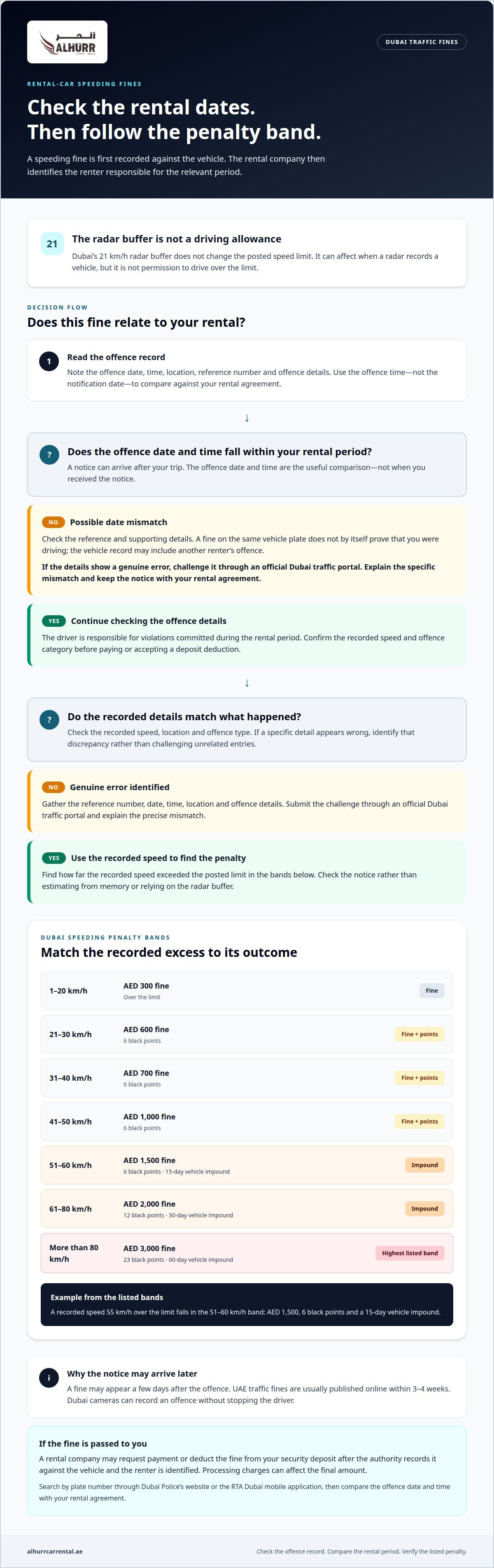
Dubai’s 21 km/h radar buffer doesn’t change the posted speed limit. A fine for speeding 1-20 km/h over the limit is AED 300, and for speeding fines in a rental car in Dubai, the offence is first recorded against the vehicle before the rental company passes it to the renter. The buffer can affect when a radar records a vehicle, but it isn’t permission to drive over the limit.
It’s understandable to question a speeding fine in a rental car in Dubai if the recorded speed, location or rental dates seem wrong. You can dispute a Dubai traffic fine through official traffic portals when you believe there is a genuine error. Check the offence details to see what was recorded.
This guide explains who is responsible for a rental-car speeding fine, what to review before disputing it and when a fine may be deducted from your deposit. It also covers black points and vehicle impoundment, and explains why Dubai’s radar buffer is a detection threshold, not a safe driving allowance.
Key Takeaways
- A rental-car fine is first recorded against the vehicle, then passed to the renter responsible during the rental period.
- Compare the offence date and time with your rental dates, and request the violation details if anything appears incorrect.
- You can dispute a fine through official Dubai traffic portals when there is a genuine error.
- A fine may be paid directly or deducted from your deposit, and processing charges can affect the final amount.
- Serious speeding can bring black points and vehicle impoundment, so the consequences may extend beyond the fine.
Can You Dispute Speeding Fines in a Rental Car in Dubai?
Yes. You can dispute a Dubai traffic fine through official traffic portals if you believe a genuine error occurred. Compare the recorded offence details with your rental dates first, and identify the specific discrepancy.
Checking Fine Details Against the Rental Period
Match the fine’s recorded date, time and offence type against the period covered by your rental agreement. A notice can arrive after your trip, even if the violation occurred during it. Use the offence time, not the notification date, to determine whether the charge relates to your rental.
Check the reference number, location and offence details on the notice or supporting record. Compare them with your booking dates before paying or accepting a deposit deduction. A vehicle record may include fines from other renters, so an entry against the same plate does not by itself prove you were driving.
Dubai speeding penalties depend on how far the recorded speed exceeds the limit. The listed bands are:
- 1-20 km/h over the limit: AED 300.
- 21-30 km/h over: AED 600 and 6 black points.
- 31-40 km/h over: AED 700 and 6 black points.
- 41-50 km/h over: AED 1,000 and 6 black points.
- 51-60 km/h over: AED 1,500, 6 black points and a 15-day vehicle impound.
- 61-80 km/h over: AED 2,000, 12 black points and a 30-day vehicle impound.
- More than 80 km/h over: AED 3,000, 23 black points and a 60-day vehicle impound.
These bands distinguish a basic fine from penalties that also affect the driver’s record or the vehicle. For example, a recorded speed 55 km/h over the limit falls in the 51-60 km/h band. Check the speed and offence category shown on the notice, rather than estimating the excess from memory or relying on a general radar buffer.
Disputing an Incorrect Traffic Fine
A dispute is a formal challenge to a fine that appears to contain an error. You can challenge a Dubai traffic fine through official portals when you have a genuine reason. Gather the reference number, date, time, location and offence details, then explain the precise mismatch, such as an offence time outside your rental period.
Keep the notice and rental agreement together while the issue is being considered. If the vehicle record shows an offence from another renter’s period, point out the date mismatch rather than challenging unrelated entries. If a rental-car speeding fine arrives after your rental ends, compare its offence time with your agreement and use the official dispute process if the details show an error.
Who is responsible for fines in a rental car in Dubai?
The driver is responsible for traffic violations committed during the rental period. Since the vehicle is registered to the rental company, the fine is initially recorded against its plate before being passed to the renter.
Tourists, UAE residents and rental-car drivers face the same Dubai traffic penalties for the same violation. Renting a car changes how a fine is recorded and billed, not the offence itself.
Fine Processing and Appearance
Fine processing is the route from a camera-recorded violation to a notice and payment request. Dubai cameras can record traffic offences without stopping the driver, so you may learn about an incident later. A fine may appear a few days after the offence, while UAE traffic fines are usually published online within 3-4 weeks. That delay makes the offence date more useful than the notification date.
Rental companies receive authority notifications for fines involving their vehicles, identify the renter for the relevant period and request payment. You can search for a Dubai fine by plate number through Dubai Police’s website or the RTA Dubai mobile application. Match the violation date and time to your rental period rather than assuming every entry on the vehicle record is yours.
Fines for Tourists, Residents, and Rental Cars
Dubai’s traffic penalty depends on the violation, not whether the driver is a tourist or resident. With a rental car, the plate belongs to the rental company, so the company initially receives the fine and passes it to the renter responsible during that period. This distinction matters when a notice arrives after you return the car.
For example, a visitor and a UAE resident who commit the same traffic offence face the same listed penalty. With a rental, however, the notification may reach the company first. Review the violation date, time and type before paying or accepting a deposit deduction.
Other common Dubai violations carry separate penalties. Tailgating carries AED 400 and 4 black points. Running a red light carries a base fine of AED 1,000 and 12 black points. Sudden, unindicated lane changes or cutting across traffic can also result in AED 1,000. These are distinct offences, so identify the exact violation on the notice.
Reduce the risk by following posted speed limits, checking parking signs and watching for radar zones. Navigation apps can show speed limits, but keep following road signs as you drive. Avoid handheld phone use and leave space between vehicles. A rushed lane change or missed parking restriction can lead to a separate fine.
For a trip that needs a car for a defined period, explore daily car rental options and plan your Dubai driving around posted signs and traffic rules.
When Does The Rental Company Deduct From Your Deposit?
A rental company may deduct a Dubai traffic fine from your security deposit after authorities record it against the vehicle and the company identifies the renter. The rental agreement and offence details help establish the charge and any processing fee.
Rental-Company Fine Notifications
A fine notification tells the driver that a traffic offence has been recorded and payment is due. Rental companies may send it by SMS or email, issue a notice after the rental ends, or deduct the amount from the deposit. Cameras can record Dubai traffic violations without stopping the driver, so a notice may arrive after you return the car.
Read the notice alongside your rental agreement. Match the offence date, time and details to the period you had the vehicle. If you see a deduction without an earlier message, ask for the fine reference and offence information to identify what the charge covers.
Authorities notify rental companies when their vehicles incur fines. The company identifies the renter linked to the relevant period, then requests payment or processes the amount against the deposit. A fine received after you return the car can still relate to your trip if its recorded offence time falls within your rental dates.
Payment may be handled in different ways. The rental company may ask you to pay the traffic fine directly, deduct it from your deposit or charge it to your credit card. Keep the notification and payment record together. If there is more than one entry, compare each reference and offence date separately rather than treating the vehicle’s entire fine record as yours.
Processing and Administration Fees
A processing or administration fee covers the rental company’s handling of a traffic fine. The total deduction may therefore exceed the government fine itself. Check the rental agreement for applicable terms, and review the notice or itemised charge for the fine and any separate processing amount.
Reported fee structures vary. Some Dubai rental companies add AED 50 to AED 100 per traffic fine; another stated structure includes an AED 20 acknowledgment fee and a 10% service charge. For fines under AED 200, that structure applies a minimum service charge of AED 20, with 5% VAT on the service charge.
Other reported UAE rental-company charges describe a service fee plus VAT that can increase the final fine amount by 10-15%. These figures reflect different fee approaches, not one universal charge. Check the rental agreement and itemised notice to see which fee applies to your case, and distinguish it from the traffic fine imposed for the violation.
If a deposit deduction does not match the fine notice or agreement, request an itemised breakdown before treating the amount as settled. Compare the fine, service charge and any VAT as separate line items.
Black points and vehicle impoundment
A speeding offence can affect more than the rental bill: serious violations may add black points to a driver’s record and lead to vehicle impoundment. These consequences are separate from a fine or security deposit charge, so check both the offence penalty and its effect on the vehicle.
Black points attach to the driver’s record, while a rental-car fine is initially associated with the vehicle. Paying or disputing the financial charge does not, by itself, explain what happens to points. For speeding offences in Dubai, the penalty rises with the excess speed, and higher bands can include both points and impoundment.
Impoundment applies to the vehicle, which creates a practical issue when it is rented. The rental vehicle may be held rather than returned to normal use, while responsibility for the violation remains connected to the driver. A rental fine notice and an impoundment consequence are not the same charge. Review the offence details to see which penalties apply.
Dubai’s speeding bands include escalating consequences:
- Speeding 51-60 km/h over the limit carries AED 1,500, 6 black points and a 15-day impound.
- Speeding 61-80 km/h over the limit carries AED 2,000, 12 black points and a 30-day impound.
- Speeding more than 80 km/h over the limit carries AED 3,000, 23 black points and a 60-day impound.
Dubai’s black-point limit is 24 points. Accumulating 24 black points over 12 months results in licence suspension, and reaching the maximum sends the case to court. Points lapse one year after the violation. Keep track of the offence date and points shown on your record, because the relevant period runs from the violation rather than your rental return.
For a speeding impound, the vehicle owner may release a light vehicle by paying AED 100 for each day of the impound or remaining impound period. That release cost concerns the impounded vehicle; it is distinct from the speeding fine and any rental-company processing charge. The rental agreement may also determine how costs relating to the vehicle are handled.
Dubai Decree No. 30 of 2023 makes a vehicle with more than AED 6,000 in recorded traffic fines grounds for impoundment. This concerns the vehicle’s recorded fines, not only one speeding incident. Check whether the notice relates to your rental period, and keep the fine reference and offence details with your records.
If an impoundment or black-point entry seems linked to the wrong offence or driver, use the official dispute route for the traffic fine and keep the relevant documents. Treat the fine, points and vehicle status as separate parts of the case. Resolving one does not automatically resolve the others.
Dubai's speeding grace buffer
Dubai’s commonly reported radar control speed is 21 km/h above the posted limit, but that buffer is not permission to speed. A reported radar threshold should not be treated as an instruction to drive above the posted limit. Keep to the speed shown on signs, since separate information reports radar triggers at 1 km/h over.
Those figures describe different reported aspects of enforcement, so don’t treat the buffer as a guaranteed margin. Dubai radar control speeds are usually set 21 km/h above posted limits, while radar triggers are also reported at 1 km/h over. For drivers, the practical takeaway is straightforward: follow the posted limit rather than calculating a speed allowance.
Sheikh Zayed Road provides an example: its posted speed limit is 100 km/h, with a commonly cited radar threshold of 120 km/h. That example illustrates the reported buffer, but it does not change the posted limit. The threshold should not be used to decide how fast to drive, especially when the limit or road conditions change along a route.
Speed limits vary by road, so pay attention to signs as you move between streets and highways. Dubai Police’s listed speed-limit page was dated January 2026. From November 2026, the reported limit on Al Asayel Street increases from 60 to 80 km/h. Use the signs on the road you are travelling, rather than relying on a remembered limit or an older route detail.
Abu Dhabi follows a different approach. Its stated example gives a posted limit of 120 km/h and radar activation at 121 km/h, with no speeding buffer. If a journey crosses from Dubai into Abu Dhabi, don’t carry a Dubai radar threshold into the next emirate. Follow the posted signs in each place.
A radar threshold does not affect payment procedures, parking fines or the recorded offence. A speeding notice is assessed using its recorded details, including location and speed. Parking restrictions are separate, so a reported camera allowance does not change where you may park or whether a parking rule applies.
Keep these driving habits in mind:
- Follow the speed shown on the current road sign.
- Recheck limits when the road or emirate changes.
- Review a notice using its recorded speed and location, not an assumed buffer.
Plan your route around posted speed limits, and keep your attention on changing road signs throughout the drive.
Al Hurr Car Rental: Daily Car Rental
Al Hurr Car Rental offers Daily Car Rental for journeys that require a car for a shorter period. If you expect to drive in Dubai, read your rental agreement before setting off and note how traffic fines and any deposit deductions are handled.
For a longer stay, Weekly Car Rental and Monthly Car Rental offer other rental-period options. Choosing a period that fits your plans can make it easier to track which rental dates relate to a fine notice. Driving rules and posted speed limits apply throughout your trip.
Review your rental details and choose the option that suits your travel plans. Contact Al Hurr Car Rental to discuss your rental needs.
Make Your Next Dubai Drive Easier to Plan
Make speeding fines in a rental car in Dubai part of your travel planning. Before your trip, consider where you’ll drive, how long you’ll need a vehicle and how you’ll keep your rental paperwork accessible. Having a clear plan makes it easier to understand any notice that arrives and connect it to the right journey.
Choose a rental period that suits your itinerary, and keep your agreement and booking details somewhere easy to find. This preparation can help you deal calmly with traffic notices, without letting an unexpected message take over your plans.
For a rental that fits your time in the UAE, speak with Al Hurr Car Rental about your requirements. Contact Al Hurr Car Rental to discuss your next journey, and set out ready to enjoy your travels.
Frequently Asked Questions
What If You Get a Fine in a Rental Car?
Keep the fine notice and rental paperwork together until the charge is resolved. Note the reference number and save any message about payment or a deposit deduction. If the details seem inconsistent, explain the specific discrepancy rather than disputing the entire vehicle record. This gives the rental company or traffic authority a clear point to review, such as an offence date that does not match your booking.
Can tourists driving rental cars check fines directly?
Yes. A tourist can search for a fine using the rental car’s plate details, then compare the notice with the rental paperwork. Keep a copy of the agreement after returning the vehicle, since the traffic record can be updated later. If a search result shows an unfamiliar entry, use its offence date and reference to distinguish it from charges related to your trip.
What Types Of Fines Should You Watch Out For?
Besides speeding, watch for parking violations, missed signals, tailgating, phone use and Salik toll violations. Salik penalties for an unregistered tag are AED 100 for the first offence, AED 200 for the next, and AED 400 for each further offence after the registration deadline. Check the notice category carefully, since a toll-related charge is different from a moving traffic violation.
What are the speeding fines in Dubai by how many km/h over the limit?
The fine depends on the recorded excess speed, with higher bands carrying higher penalties. Use the fine table in the article to find the relevant band rather than estimating the amount from memory. When reviewing a notice, focus on the recorded speed and the applicable limit at the stated location. Those details determine which band applies.
Are there additional black points or vehicle impoundment penalties for speeding in Dubai?
Yes. Some speeding offences carry black points on the driver’s record, while more serious cases can also lead to vehicle impoundment. These consequences affect different things: points relate to the driver, and impoundment concerns the vehicle. Treat any notice about points or vehicle status separately from the rental company’s payment request, and keep both records.
What is Dubai's speeding buffer, and does it apply on all roads?
Dubai’s reported radar threshold is not a safe speed allowance and should not guide how fast you drive. Road limits can change along a route, so follow the posted limit at each point rather than relying on a threshold from another road. If a notice seems inconsistent with the limit at that location, use the recorded location and speed when reviewing it.
How can drivers check and pay Dubai speeding fines online?
Dubai Police’s fine service supports searches by vehicle plate, driving licence or traffic code. Accepted payment cards depend on the service: Dubai Police’s fine service accepts cards issued in the UAE or GCC, while payment through the MOI UAE app requires a local bank card. If you cannot pay online, follow the payment route stated in your fine notice.
Who is responsible for paying a speeding fine in a Dubai rental car?
The renter is responsible for a traffic fine linked to their rental period. Since the vehicle’s registration can cause the initial notice to reach the rental company, the company identifies the renter and requests payment. If the notice arrives after you return the car, use the offence date, not the message delivery date, to match it to your booking.