Car Rental or Ownership in Dubai: Compare the Costs

Compare the cost of living in Dubai car rental vs ownership, including insurance, maintenance, depreciation and resale, to find the right option for your stay.
Owning a car isn’t automatically the cheaper choice. Whether you live in Dubai or anywhere else across the UAE, the overall cost of living in Dubai car rental vs ownership depends on how long you need a vehicle and whether you account for insurance, maintenance, depreciation and resale, rather than just focusing on a monthly payment.
Buying gives you an asset you can sell later, but its value may fall while ownership costs continue to accumulate. Renting through a trusted provider like Al Hurr Car Rental avoids the purchase decision and resale process, although the agreement and your driving needs shape the overall cost. The right choice depends on the full picture, not one headline figure.
This comparison looks at monthly rental and lease-to-own alongside the costs of buying, including insurance, upkeep, depreciation and resale. It also covers the factors that matter for a short visit, a longer stay or regular driving throughout the UAE, so you can choose based on your exact needs.
Key Takeaways
- Compare the full cost of driving, not just a rental payment or car-loan instalment. Insurance, upkeep, tolls, parking and resale can change which option makes more sense.
- Look beyond the monthly rent-to-own payment: the upfront amount, scheduled instalments and end-of-term purchase amount all affect the total.
- Check what a rental agreement includes, especially insurance and maintenance, and account for any expenses that remain your responsibility.
- Depreciation reduces a car’s resale value, so include the likely loss in value when estimating the true cost of ownership.
- Choose an option that fits how long you’ll need a car and how much flexibility you want, then explore the relevant rental or leasing arrangement.
Monthly Car Rental Dubai vs Buying: Cost of Living, Car Rental vs Ownership
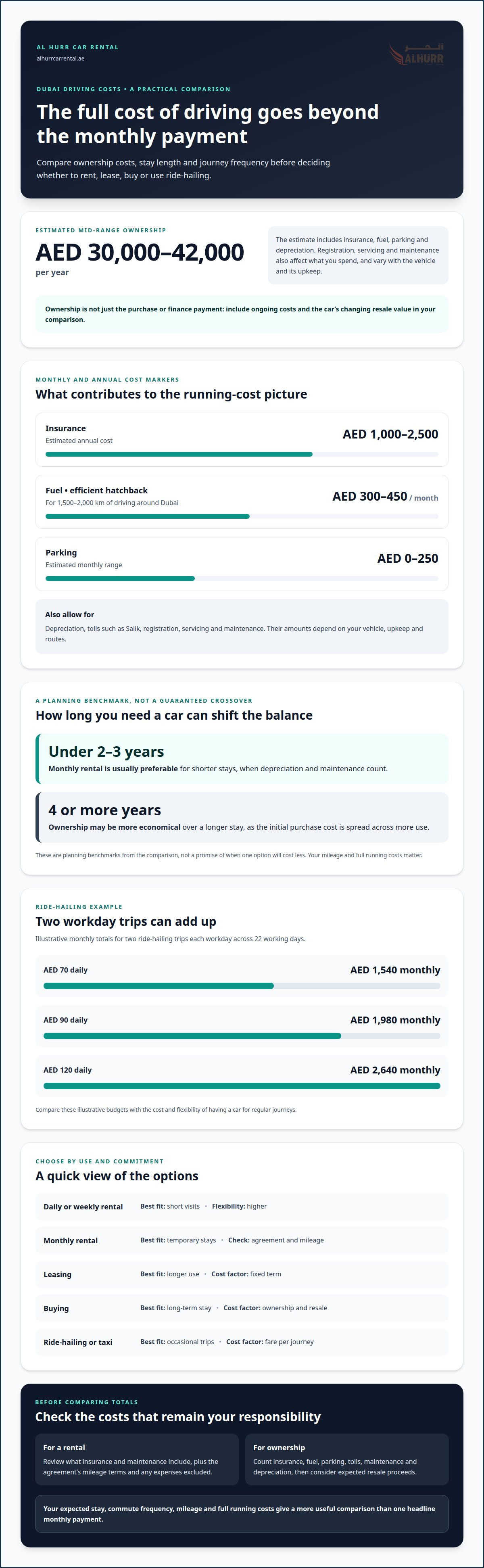
Compare the full monthly outlay. Ownership estimates should include insurance, fuel, parking and depreciation, while tolls and mileage add running costs. The cost of living in Dubai also depends on whether you rent or own your car.
Daily and Weekly Rental Costs
Daily and weekly rentals suit short visits or changing plans; leasing is designed for longer-term use. A monthly arrangement can make costs easier to plan, while buying requires a larger upfront commitment and leaves resale to you. Your mileage and length of stay in Dubai affect which option fits best.
For rentals, UAE residents need an Emirates ID and a valid UAE driving licence. Tourists need a passport, valid visa and home-country licence, plus an International Driving Permit if required.
Ownership and Running Costs
Mid-range ownership is estimated at AED 30,000-42,000 annually, including insurance, fuel, parking and depreciation. Insurance alone is estimated at AED 1,000-2,500 annually. Owners also handle registration, servicing and maintenance; these costs vary with the vehicle and its upkeep. Fuel, parking and Salik crossings add to the total.
Fuel for an efficient hatchback driven 1,500-2,000 km around Dubai is estimated at AED 300-450 monthly. Parking can range from AED 0-250 monthly. Toll charges can add to your overall costs, depending on your routes. Include these expenses in your cost-of-living comparison of renting and owning.
Stay Length and Cost Crossover
Monthly rental is usually preferable for stays under 2-3 years, when depreciation and maintenance count. Ownership may be more economical for a stay of four or more years; a longer period spreads the initial purchase cost over more use. These are planning benchmarks, not a guaranteed crossover point.
| Option | Best fit | Cost factor | Flexibility |
|---|---|---|---|
| Daily or weekly rental | Short visit | Rental term | Higher |
| Monthly rental | Temporary stay | Agreement and mileage | Moderate |
| Leasing | Longer use | Fixed term | Lower |
| Buying | Long-term stay | Ownership and resale | Ownership control |
| Ride-hailing or taxi | Occasional trips | Fare per journey | High |
Choose by comparing your expected stay, commute frequency, mileage and full running costs.
For two ride-hailing trips each workday across 22 working days, AED 70 daily totals AED 1,540 monthly; AED 90 totals AED 1,980, and AED 120 totals AED 2,640. Compare those illustrative ride-hailing or taxi budgets with the cost and flexibility of having a car for regular journeys. This helps you assess car rental versus ownership as part of your Dubai living costs.
Rent-to-own monthly payments and end-of-term purchase amounts
Long-term rental gives you a vehicle for an agreed period without making a purchase part of the arrangement. Leasing also sets a term and regular payments, while lease-to-own links scheduled payments to a possible purchase at the end. Buying gives you ownership, but also leaves resale and ongoing vehicle costs to you.
For lease-to-own, consider the full payment structure rather than focusing only on the monthly amount. Separate any initial payment, scheduled instalments, compulsory charges and final purchase amount. That final amount can substantially change the total commitment. Keep any refundable security deposit separate from acquisition costs, and understand the terms for its return.
Lease terms can run for 12, 24 or 36 months. Fixed monthly payments can help you plan, but they don’t show the full cost by themselves. Compare the payment schedule, upfront amount, end payment, included insurance or maintenance, mileage terms and charges excluded from the agreement. A lower instalment may accompany a larger final payment.
| Option | Payment structure | End position | Key comparison |
|---|---|---|---|
| Monthly rental | Payments for the agreed term | Return the vehicle | Agreement inclusions and mileage |
| Lease | Payments across a fixed term | Contract terms determine the outcome | Term, included costs and conditions |
| Rent-to-own | Initial and scheduled payments | A purchase amount may be due | Total acquisition outlay |
| Buying | Upfront funds or finance payments | You own the vehicle | Running costs and resale value |
Compare costs line by line. Add the scheduled payments and any final amount, then account for fuel, tolls, parking and maintenance or consumables excluded from the agreement. For ownership, include insurance, servicing and expected resale proceeds. If you value flexibility, renting may suit you; if you want to own the vehicle at the end, consider lease-to-own.
Long-term rental suits drivers who need a car without planning to purchase it. Leasing provides a defined term, while rent-to-own connects payments with a possible later acquisition. Read the end-of-term conditions and payment schedule together. You can compare those details with the lease-to-own arrangement when deciding how long you plan to use a vehicle.
Does a monthly rental include insurance and maintenance?
Monthly rental packages in Dubai often include insurance, maintenance, servicing and roadside assistance. The agreement sets the actual cover and responsibilities, so compare its inclusions with the costs you would manage after a purchase.
Basic insurance can make monthly budgeting more predictable, but it doesn’t remove every potential expense. Check what the policy covers, who pays any insurance excess after damage, and whether an optional damage waiver changes that responsibility. The excess and waiver terms matter most if an incident occurs, so review them alongside the rental payment.
Maintenance arrangements depend on the agreement. Check whether routine servicing and repairs are included and how to arrange service during your rental. For example, if servicing falls due, the contract should explain the process and whether a replacement vehicle is included. Don’t assume every rental handles maintenance in the same way.
Mileage limits affect the value of included maintenance and insurance. One Dubai economy-rental example sets an allowance of 4,500 km per month. If your commute and weekend trips take you beyond the stated allowance, additional mileage terms may affect your budget. Compare the limit with your expected driving before deciding.
Registration is another difference between renting and buying. Car registration is mandatory in Dubai. With ownership, registration and renewal are tasks associated with your vehicle; with a rental, read the agreement to understand how registration is handled and whether any related charge is included.
Roadside assistance can help if the vehicle breaks down, while routine maintenance helps keep it serviced. Check the agreement for the assistance process, covered situations and exclusions. A tyre issue or damage caused during use, for example, may be treated differently from a mechanical fault. Clear terms help you plan without assuming every call-out is covered.
For ownership, insurance, servicing and repairs sit alongside depreciation and eventual resale value. Rental shifts some vehicle costs into the agreement, but fuel, Salik and parking still affect your driving budget. Compare the full monthly outlay, not just the rental payment or purchase cost.
Before signing, review the agreement for insurance cover, excess, damage-waiver terms, mileage, routine maintenance, registration and roadside assistance. Those details show which costs are predictable and which remain your responsibility.
Depreciation and resale value
Buying a car means paying for more than its purchase price. In Dubai, depreciation reduces the vehicle’s value over time, while resale may recover part of its cost.
Vehicle Depreciation
Cars in Dubai may lose 20-30% of their value within the first year. That reduction is an ownership expense, even though it doesn’t appear as a monthly bill. To estimate the cost, compare the purchase price with the expected resale value, then include insurance, servicing and other running expenses.
For example, a buyer of a new vehicle should account for the difference between its initial price and its later market value. A luxury model and an economy car may depreciate differently, so don’t assume one rate applies to every vehicle. Driving distance, condition and demand can also affect resale expectations.
Resale Value
Resale value offsets some ownership costs, but it isn’t guaranteed income. A well-maintained vehicle may appeal to more buyers than one with visible wear or incomplete service records. When estimating total cost, use a cautious resale expectation and subtract it from the purchase price rather than treating the original outlay as the whole expense.
Consider a driver who buys for convenience but leaves Dubai sooner than expected. Selling then may leave less time to benefit from ownership, while depreciation has already reduced the vehicle’s value. Someone who keeps the car longer can spread the initial purchase cost across more years of driving.
With renting, your payments cover use during the agreement, and you don’t receive resale proceeds when it ends. That removes the need to sell the vehicle, but rental payments don’t build ownership value. Compare rental costs over your intended stay with ownership costs after estimated resale, insurance, servicing and depreciation.
For a practical comparison, write down the purchase price, expected resale value and ownership expenses. Then compare that total with rental payments over the same period. Include your planned mileage and how long you expect to drive in Dubai. This shows whether resale meaningfully changes the cost, rather than relying on the purchase price alone.
Registration and maintenance responsibilities
Ownership means managing the vehicle’s paperwork and upkeep. Car registration is required in Dubai, while a rental agreement sets out how registration and maintenance responsibilities are handled during your rental.
For an owned car, registration, servicing and repairs are part of your ownership commitment. A scheduled service, worn component or unexpected fault can each create a separate expense. For a rental, read the agreement to see whether routine maintenance and servicing are included and how to report a repair. Don’t assume damage and mechanical faults follow the same process.
There isn’t one typical maintenance or repair cost for Dubai drivers. The amount depends on the vehicle, its condition, mileage, service needs, parts and type of repair. Routine servicing and repairs after a mechanical fault are different expenses, so account for both in an ownership budget rather than relying on a single estimate.
Fuel is another running expense for both rented and owned cars. You pay for the fuel you use, and your monthly total changes with driving distance, traffic and vehicle efficiency. For example, a resident with a longer commute will use more fuel than someone who drives mainly for local errands.
Salik tolls and parking affect the day-to-day cost of driving, depending on your routes, neighbourhood, workplace and routine. These usage-based expenses remain separate from maintenance, whether you own the car or rent it.
A rental deposit is separate from ongoing repair expenses. Treat it as an upfront cash requirement and review the agreement’s terms for how it is handled. Before committing, identify who arranges routine servicing, who pays for repairs, how insurance excess applies and which running costs you pay directly.
For residents choosing between renting and ownership, lifestyle and length of stay matter. Renting can limit your responsibility for scheduled upkeep when the agreement includes maintenance; ownership gives you control but leaves you to arrange servicing and repairs. Compare the agreement’s inclusions with the vehicle’s expected maintenance needs, then account for fuel, Salik and parking.
Review rental agreement details to understand how a longer-term arrangement fits your driving routine and responsibilities.
There is no single typical cost: expenses vary with the car’s condition, mileage, parts and required work. Budget separately for scheduled servicing and repairs.
Al Hurr Car Rental
Al Hurr Car Rental offers rental and leasing options to consider when you need a car in Dubai but aren’t ready to buy. The right fit depends on how long you need a vehicle, how often you’ll drive and whether keeping ownership matters to you.
For a short visit or brief change in routine, Daily Car Rental can match a limited period of use. Weekly Car Rental gives you a longer rental without committing to a monthly arrangement. If you need a vehicle for an extended stay, Monthly Car Rental offers a longer-term option. Leasing Car is another choice for ongoing use. Each option suits a different timeframe, so match the arrangement to your plans rather than choosing by payment frequency alone.
Before deciding, outline your expected stay, regular journeys and likely mileage. Then consider the costs that matter to you: rental payments, fuel, Salik, parking and any agreement terms affecting maintenance or insurance. Al Hurr Car Rental provides transparent pricing with no hidden fees. Buying requires a purchase commitment and leaves you responsible for ownership expenses and resale. Renting avoids owning the vehicle, while leasing provides a separate arrangement for longer-term use. Compare the total costs and responsibilities that apply to your situation.
You might value flexibility if your Dubai plans could change, or prefer ownership if you expect to keep a car long term. Daily or weekly rental can suit a shorter need; monthly rental or leasing may fit a longer one. Weigh these options against your expected driving, budget and preferred level of responsibility. No arrangement is guaranteed to cost less in every situation.
Al Hurr Car Rental offers rental and leasing options for different periods of use. Choose the timeframe that matches your plans, then review the terms and costs for that arrangement. Keep your comparison focused on the full commitment, including running costs and whether ownership or resale is part of your goal.
For a clear comparison, consider the period you need a car, how you’ll use it, and whether you want to own it at the end. Contact Al Hurr Car Rental to discuss the option that suits your plans.
Choose the arrangement that fits your next chapter
The cost of living in Dubai car rental vs ownership is a personal decision shaped by how you want to use your time and money. Before choosing, decide what matters most: having a car for a short visit, keeping transport flexible during a temporary stay or planning for regular use over a longer period.
Then match your next step to that timeframe. Daily Car Rental and Weekly Car Rental suit shorter needs, while Monthly Car Rental provides a longer rental option. Think about the journeys you expect to make and how much responsibility you want for a vehicle. A clear preference can help you move from comparing options to choosing an arrangement with confidence.
You don’t need to make the decision based on one payment alone. Choose the option that fits your plans and feels manageable for your routine. For a friendly conversation about your options, contact Al Hurr Car Rental. Your next drive in Dubai can start with a choice that works for you.
Frequently Asked Questions
Is It Better to Rent a Car or Buy a Car in Dubai?
Renting may suit you if you value flexibility or your plans could change. Buying can work if you expect to keep using the same vehicle and want ownership. Compare your driving pattern, available upfront funds and willingness to handle repairs and resale. A resident with a stable routine may weigh these factors differently from a visitor on a temporary stay.
Is there a balloon payment or final lump sum to own the car, or is it fully EMI-based?
It depends on the lease-to-own agreement: payments may include a final purchase amount, not just fixed instalments. Before signing, identify the initial payment, every scheduled payment, compulsory charges and the amount due to acquire the car. Review how the agreement treats early termination and missed payments. This gives you a clearer picture of the total commitment than the monthly instalment alone.
Is there a long-term contract or can I stop any month?
The contract determines the commitment period and whether you can end it early. A monthly payment doesn’t automatically mean you can stop at the end of any month. Read the notice requirements, early termination conditions and any charges that apply if your plans change. For example, a driver whose work assignment may end unexpectedly should compare flexibility before choosing a fixed-term arrangement.
Is there any obligation to purchase the car at the end of the lease term?
Not every lease requires you to buy the vehicle. Standard leasing and lease-to-own serve different purposes, so the signed terms matter. Look for wording that explains whether purchase is optional, required or subject to a final payment. If ownership is your goal, confirm how the agreement handles the transfer and what amount remains due at the end.
Is renting a car cheaper than buying one?
Neither option is always cheaper; compare the total cost over the same period. For ownership, include purchase costs, insurance, upkeep, fuel, parking and expected resale proceeds. For renting, consider the agreement’s payments, mileage terms and costs outside the package. Your commute also matters: regular driving can change the comparison more than occasional weekend use.
What is the average monthly cost of renting a car in Dubai?
Monthly rental costs vary with vehicle category, rental length and agreement terms. Rather than treating one average as a personal quote, compare the full amount for the vehicle and term you need. Include mileage conditions and costs you pay separately, such as fuel, Salik and parking. A monthly plan may suit a longer stay better than repeatedly arranging short rentals.
What is the average cost of buying a car in Dubai?
A mid-range sedan in Dubai costs AED 60,000 or more to purchase. The purchase price is only the starting point: ownership also brings insurance, maintenance, fuel, parking, and depreciation. For those seeking manageable entry prices and financing, exploring used cars for sale all credit accepted offers an accessible route to ownership. Your eventual resale proceeds can offset part of the expense, but they depend on the vehicle’s condition and market demand. Compare the ownership total with your expected period of use.
How much do car insurance, registration, and annual inspection cost in Dubai?
Car insurance in Dubai is estimated at AED 1,000-2,500 annually. According to the RTA, car registration is mandatory, but registration and inspection expenses depend on the vehicle and applicable requirements. Treat these as separate budget items rather than assuming insurance covers them. The vehicle’s condition and the work needed to pass an inspection can also affect your overall ownership costs.